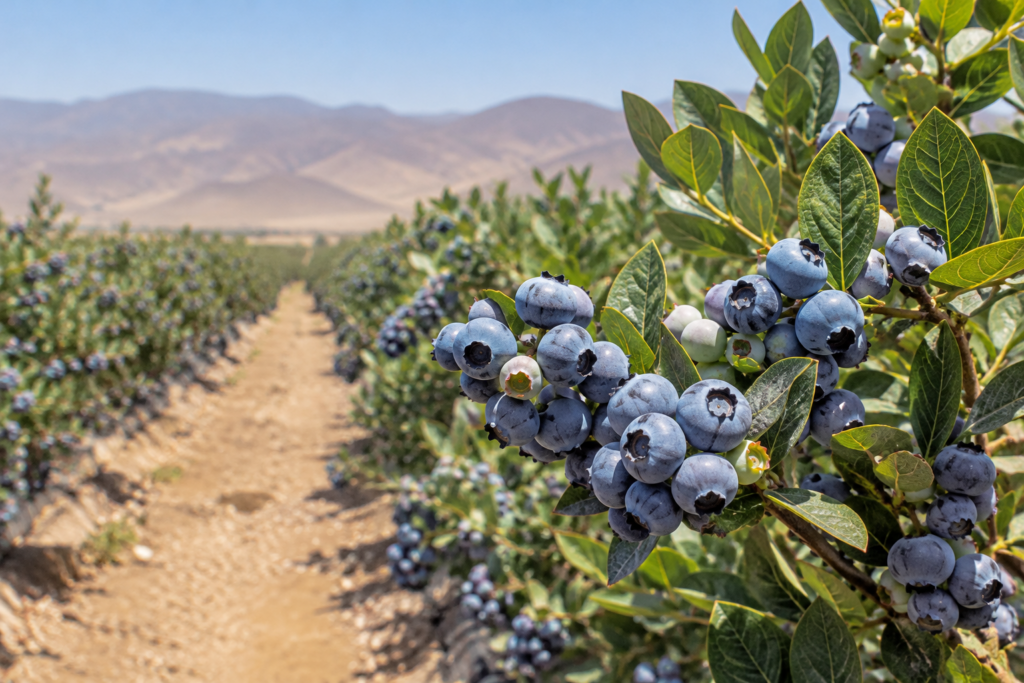
Peru, the world’s largest exporter of fresh blueberries and the main source of U.S. supply each fall, has lowered its season outlook for the fourth time in three months. In its sixth export projection, released October 14, industry association Proarándanos now expects Peru to ship about 344,000 metric tons of fresh blueberries in the 2026/27 campaign. That is 6.1% below the 366,000-ton estimate issued in early October and 10.3% below the 383,000 tons exported last season, even though roughly 15% more hectares are in production.
For U.S. retailers, distributors and foodservice buyers, the bigger story is timing: most of the shortfall lands in the weeks between now and the end of December, which is normally the heart of Peru’s shipping season.
Four Forecasts, One Direction
Each Proarándanos update since August has moved lower. The season-total estimate has now fallen by about 60,000 tons, or roughly 15%, from the initial projection.
| Proarándanos forecast | Season total (metric tons) | Change vs. prior forecast |
| August (initial) | 404,000 | n/a |
| September | 382,000 | -5.4% |
| Early October (fifth) | 366,000 | -4.2% |
| October 14 (sixth) | 344,000 | -6.1% |
| 2025/26 actual exports | 383,000 | n/a |
The Shortfall Is Concentrated in the Fourth Quarter
Peru started the season strong, but that cushion is disappearing quickly:
- Through week 40: Peru had exported 163,500 tons, 4.5% more than the same point last season. Just two weeks earlier, at week 38, the lead was 18.7%.
- A lower peak: Proarándanos estimates the season’s peak came in week 40 at about 14,600 tons, roughly 30% below the 20,900 tons shipped in the same week of 2025/26.
- Weeks 41 to 53 (rest of 2026): projected exports of 133,500 tons, down 24.7% from 177,300 tons a year earlier.
- January to April 2027: about 46,600 tons, 5.3% below last season. Proarándanos calls this the most uncertain stretch because seasonal rains could change volumes significantly.
- Organic: now forecast at 24,500 tons for the season, 31.1% below last year’s 35,600 tons, with a projected peak in week 47 of only about 1,000 tons.
What Is Driving the Cuts
Proarándanos attributes the revisions to El Niño, which it says has hit harder than first expected. Warmer conditions have sped up crop development, reduced average berry size and lowered productivity in some varieties. Industry analysts in Peru have reported fruit sizing well below normal for several leading varieties, with exporters steering larger fruit toward premium programs.
The weather pattern is not limited to Peru. Naturipe has said it expects a lighter crop from South America overall, while Chile’s blueberry committee is still projecting modest growth in its first estimate of the season. Mexico, meanwhile, is increasing raspberry and blackberry shipments, not blueberries.
Why It Matters for U.S. Importers
The United States is Peru’s largest blueberry market. Through week 39, Peru had shipped about 70,300 tons to the U.S., up 26% year over year and roughly 47% of its total exports. Peru’s agriculture ministry (MIDAGRI) also reported that U.S. purchases of Peruvian blueberries rose nearly 80% in the first seven months of 2026. Heavy reliance on a single origin means a roughly 25% drop in fourth-quarter volume will be felt directly on U.S. shelves and in contract fill rates.
Cost pressure is building on two fronts. Shorter supply typically firms up pricing, and Peruvian goods have been subject to the 12.5% Section 301 forced-labor tariff since July 24, 2026, unless a product falls within one of the published exemptions. Peruvian blueberry growers have said their U.S. shipments face this rate. Fresh blueberries from Peru also remain subject to APHIS fruit fly requirements, so they must be cold treated, fumigated or irradiated under an approved schedule before release.
What Importers Should Do Now
- Revisit fourth-quarter commitments. Review volume programs, promotions and contract terms with Peruvian suppliers, assuming weekly volumes well below last year through December.
- Check size and grade specifications. With smaller fruit common this season, confirm what your suppliers can actually deliver against your specs before product ships.
- Budget for landed cost. Factor the 12.5% Section 301 duty into Peruvian pricing, and confirm your HTSUS classification and any exemption eligibility with your customs broker.
- Weigh alternate origins carefully. If you shift some volume to other suppliers, compare each origin’s tariff exposure, phytosanitary requirements and transit times, since these vary by country.
- Confirm treatment and port plans. Make sure each shipment’s APHIS treatment pathway and port of entry are set before departure to avoid holds. Our September 22 article on Chilean fruit shipping covers related East Coast fumigation and routing considerations.
- Organic buyers, plan earliest. The organic shortfall is deeper than the conventional one, so secure commitments now.
- Watch the next update. Proarándanos plans its next forecast in the first week of November. Further revisions are possible.
ASK Alba™
Importing fresh produce from Peru or other South American origins this season? Alba’s Produce & Perishable Goods team can help you review tariff exposure, APHIS treatment requirements and entry planning. Contact us to talk with a specialist.
References
- Proarándanos sixth export forecast, as reported by Blueberries Consulting (October 15, 2026)
- Proarándanos sixth export forecast, as reported by FreshPlaza (October 15, 2026)
- Proarándanos fifth export forecast and U.S. export data, FreshPlaza (October 12, 2026)
- Peru cuts blueberry export forecast amid El Niño, Food Business MEA (October 14, 2026)
- U.S. imports of Peruvian blueberries see 80 percent increase (MIDAGRI data), International Blueberry Organization
- Mexican berry shipments step up as El Niño weighs on Peruvian supply, FreshFruitPortal (October 15, 2026)
- USTR, Notice of Actions in Section 301 Forced Labor Investigations, 91 FR 47318 (July 28, 2026)
- Faced with steep U.S. import duties, growers in Chile, Peru and Morocco prepare a response, International Blueberry Organization
- USDA APHIS Fruits and Vegetables Import Requirements (FAVIR) database
- Alba: Chilean Fruit Shipping Shifts Could Reshape East Coast Import Logistics (September 22, 2026)