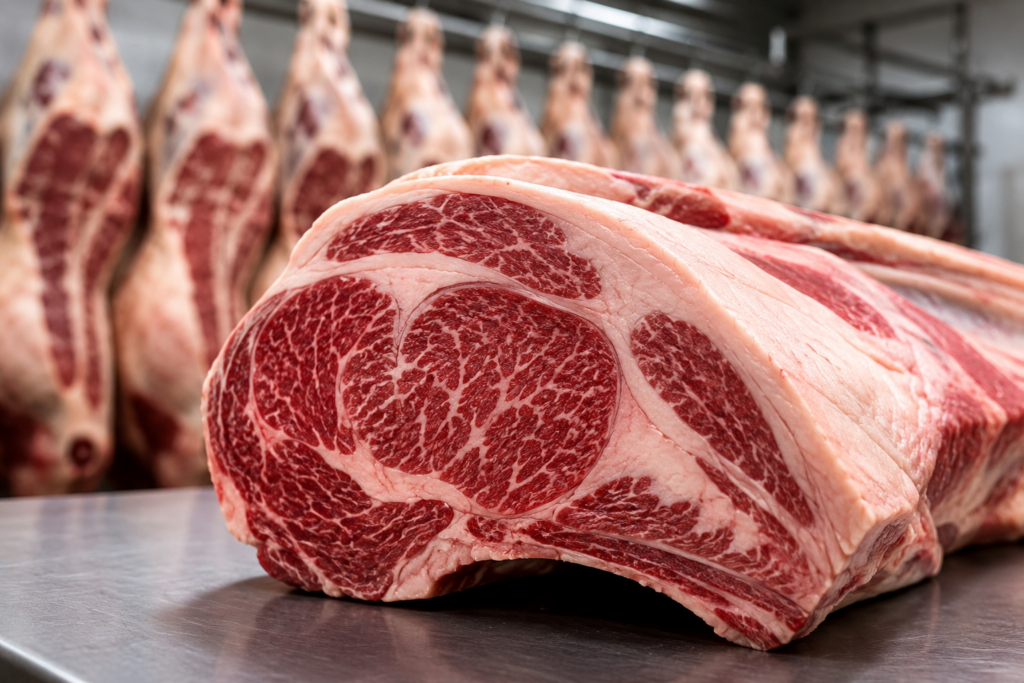
USDA’s Agricultural Marketing Service (AMS) is seeking public comment on the most significant potential revision to the United States Standards for Grades of Carcass Beef in years. The notice, published July 8, 2026 (91 FR 42172), puts two changes on the table: adding new marbling degrees to the USDA Prime grade and eliminating the skeletal maturity requirement for cattle verified under 30 months of age by dentition.
Comments are due September 8, 2026 (Docket No. AMS-LP-25-0485).
Why Prime May Get New Tiers
The review stems from a petition by the American Wagyu Association. Prime currently spans four marbling degrees, Slightly Abundant through Very Abundant, but modern genetics are producing carcasses whose marbling exceeds what those degrees can differentiate. The numbers back this up: the share of carcasses grading Prime has doubled from 6.2% in 2017 to 12.2% in 2025.
For high-marbling programs like American Wagyu, a single Prime grade no longer distinguishes their product from conventional Prime. New degrees above the current scale would let the market price that difference — much as Japan’s grading system already differentiates ultra-high-marbling beef.
The Maturity Requirement May Go
Today, carcasses are sorted into maturity groupings (A through E) using dentition or age verification alongside skeletal and lean maturity. The catch: cattle under 30 months can show physiological maturity of group B or older due to diet, breed, and other factors, pushing them out of the top grades even though research (including Colorado State University carcass studies) shows their palatability matches group A.
AMS is proposing to let dentition and age verification take priority over physiological maturity. If adopted, more carcasses would qualify for Prime, Choice, and Select without diminishing the grades’ reliability in predicting eating quality.
What This Means for Meat Traders
USDA quality grades are the common language of the global beef trade — they drive pricing, contract specifications, and foreign-market positioning. Changes here ripple through the supply chain:
- Exporters: AMS is explicitly asking how the standards could make U.S. beef more competitive internationally. New Prime tiers could sharpen U.S. positioning against Japanese and Australian Wagyu in premium markets.
- Importers and buyers: Contract specs referencing USDA grades may need revisiting if grade definitions shift or new tiers appear.
- Producers and processors: Removing the maturity requirement would move more product into higher grades, affecting premiums and procurement math.
AMS also flagged that yield grade calculations are under industry discussion and welcomes comments on that subject too.
How to Weigh In
AMS poses ten specific questions, covering everything from new marbling degree names to international competitiveness. Submit comments by September 8, 2026 at regulations.gov, referencing Docket No. AMS-LP-25-0485. If AMS proceeds, a draft of the revised standards will be published for an additional comment period.
Questions about how grading changes could affect your meat import or export program? Contact the Alba team — our meat, seafood, and dairy specialists can help you assess the impact.
Want updates like this in your inbox? Subscribe to the newsletter.