Updated September 29, 2026, to reflect that the import restrictions are now in effect.
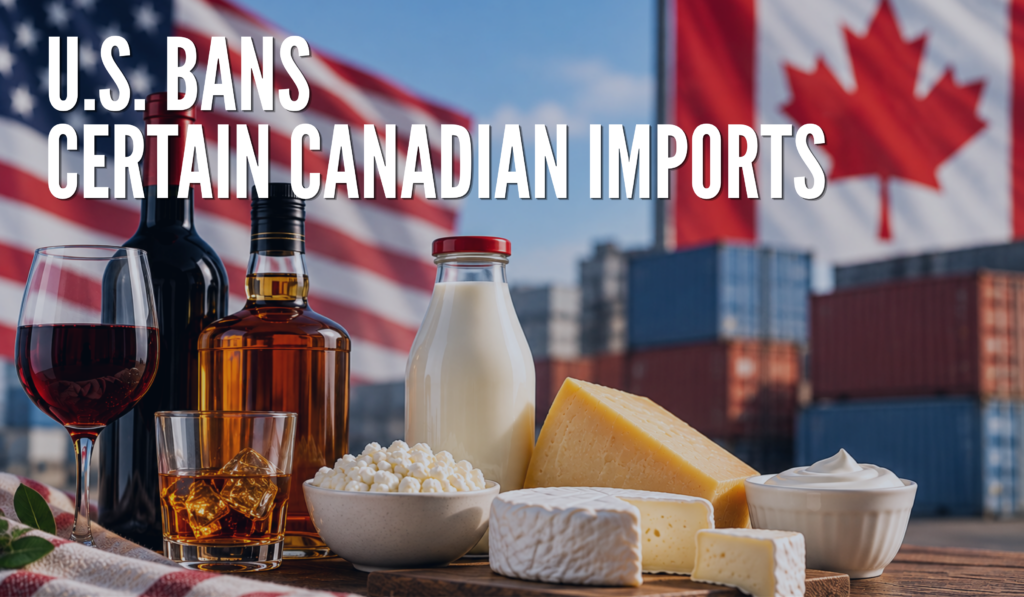
Specified Canadian alcoholic beverages, dairy-related products, motorcycles and mopeds are now prohibited from entering the United States. The import restrictions took effect at 12:01 a.m. Eastern on September 29, 2026, escalating the ongoing U.S.-Canada trade dispute from additional tariffs to outright import prohibitions.
President Trump signed five proclamations on September 8 under Section 338 of the Tariff Act of 1930, expanding actions Alba first reported when the administration invoked this rarely used authority against Canada in July.
The September measures include three import bans and two changes to the lists of Canadian products subject to the additional 50% Section 338 duties that took effect August 22.
Which Canadian Products Are Now Prohibited?
Effective September 29, certain Canadian products identified by Harmonized Tariff Schedule classifications are excluded from importation into the United States.
The affected categories include:
- Certain Canadian alcoholic beverages, including specified beer, wine and spirits
- Certain dairy-related products, including specified whey products and molasses
- Certain motorcycles and mopeds
These restrictions do not constitute a blanket ban on Canadian alcoholic beverages, dairy goods or motor vehicles. Coverage is determined by the specific HTSUS classifications listed in the annexes to the presidential proclamations.
Importers should not rely solely on a product’s commercial description. A product may appear to fall within one of the affected industries but remain outside the prohibition. Another product may be covered based on its tariff classification even if its description does not make the restriction immediately apparent.
Importers should confirm both classification and Canadian origin before determining whether merchandise is admissible.
Paying the 50% Duty No Longer Makes Newly Imported Goods Admissible
Before September 29, the covered products were subject to an additional 50% Section 338 duty. For covered merchandise imported on or after the effective time, paying that duty is no longer an option for securing admission.
The affected merchandise is now prohibited from importation.
This distinction is operationally important. A tariff increases the cost of importing merchandise, while an import prohibition prevents covered merchandise from being admitted into the United States regardless of the importer’s willingness to pay additional duties.
Importers should review goods scheduled to arrive on or after September 29 and coordinate with suppliers, carriers and customs brokers before covered merchandise reaches a U.S. port.
Transitional Treatment Applies to Certain Earlier Imports
The proclamations provide transitional treatment for merchandise imported before the restrictions took effect.
Products covered by the new bans that were imported before September 29 but had not yet been entered for consumption or withdrawn from warehouse for consumption remain subject to the applicable 50% Section 338 duty.
Covered products imported on or after September 29 are excluded from importation. Paying the 50% duty does not make those later imports admissible.
Importers must carefully distinguish among:
- Shipment date
- Export date
- Arrival date
- Importation date
- Entry date
- Withdrawal from warehouse date
These dates are not interchangeable. Merchandise already in transit, held in a bonded warehouse or awaiting entry does not automatically qualify for transitional treatment.
Companies with shipments near the September 29 cutoff should retain transportation and entry records documenting when the merchandise was imported.
Separate 50% Tariffs Remain in Place for Other Canadian Products
The import bans are separate from the revised lists of Canadian products subject to the additional 50% Section 338 duties.
Those revised tariff lists took effect on September 15 for covered goods entered for consumption, or withdrawn from warehouse for consumption, on or after 12:01 a.m. Eastern.
Certain cheeses and products within categories including paper, aluminum, other metals, furniture and related goods were added to the revised tariff lists. Certain products previously subject to the additional duties, including rock salt and cement, were removed.
The result is a product-specific trade environment in which Canadian-origin merchandise may now be:
- Prohibited from importation
- Subject to an additional 50% Section 338 duty
- Removed from the Section 338 tariff lists
- Unaffected by these particular Section 338 actions
- Subject to multiple trade measures requiring more than one Chapter 99 heading
Section 338 duties may apply in addition to Section 232 duties and other charges. Importers should calculate the complete tariff treatment and confirm the proper reporting sequence instead of treating the 50% duty as a replacement for another trade measure.
What Happens to Prohibited Merchandise?
Importers should not allow covered merchandise to arrive at a U.S. port without first determining how CBP will treat the shipment.
Depending on the facts and applicable agency instructions, prohibited merchandise may face refusal of admission and may need to be exported or otherwise handled as directed by CBP. Importers may also incur additional freight, storage, demurrage, detention and administrative costs while the merchandise is held.
Potential commercial consequences include:
- Cargo delays and holds
- Reexport expenses
- Storage and demurrage charges
- Missed customer deliveries
- Inventory shortages
- Contract disputes
- Supplier cancellation charges
- Disruption to established cross-border transportation routes
Customs brokers cannot resolve a prohibited-import issue simply by paying additional duty or changing an entry filing. Product eligibility should be confirmed before shipment whenever possible.
Why Did the United States Impose the Bans?
The actions follow an escalating series of trade measures between the United States and Canada.
The United States previously imposed 50% additional duties on specified Canadian products under Section 338. Canada subsequently implemented retaliatory tariffs of 15%, 25% and 50% on approximately C$27.6 billion in U.S.-origin goods beginning September 8.
The White House states that the U.S. restrictions respond to Canada’s continued discriminatory treatment of American products in the alcoholic beverage, dairy and motor-vehicle sectors.
Section 338 authorizes the president, under specified circumstances, to impose additional duties of up to 50% on products from a country determined to discriminate against U.S. commerce. If that discrimination continues or increases, the law also provides authority to exclude products from that country from U.S. importation.
The September 29 restrictions represent a significant escalation because the affected goods are no longer merely subject to additional tariffs. They are now inadmissible.
What Importers Should Do Now
Companies importing Canadian-origin merchandise should:
- Confirm the HTSUS classification and country of origin of each product.
- Compare current classifications against the revised Section 338 tariff lists.
- Determine whether any products are covered by the import prohibitions now in effect.
- Review goods already in transit, awaiting entry or held in bonded warehouses.
- Document the importation date for merchandise that may qualify for transitional treatment.
- Stop or redirect future shipments of prohibited merchandise before they reach a U.S. port.
- Calculate the complete duty exposure for Canadian goods that remain subject to the 50% tariff.
- Confirm the proper Chapter 99 reporting sequence with the company’s customs broker.
- Review purchase orders and contracts for tariff responsibility, cancellation rights, delivery requirements and government-action provisions.
- Evaluate alternative sourcing and inventory options for merchandise that is no longer admissible.
- Monitor CBP and Federal Register guidance for implementation instructions and technical HTSUS changes.
The situation between the United States and Canada continues to evolve, and additional changes remain possible.
Contact the Alba team for assistance evaluating Canadian-origin merchandise, reviewing affected HTSUS classifications, confirming transitional treatment, calculating stacked duty exposure or identifying alternative import strategies.
Subscribe to the ASK Alba™ Trade Brief for the latest trade and regulatory updates.