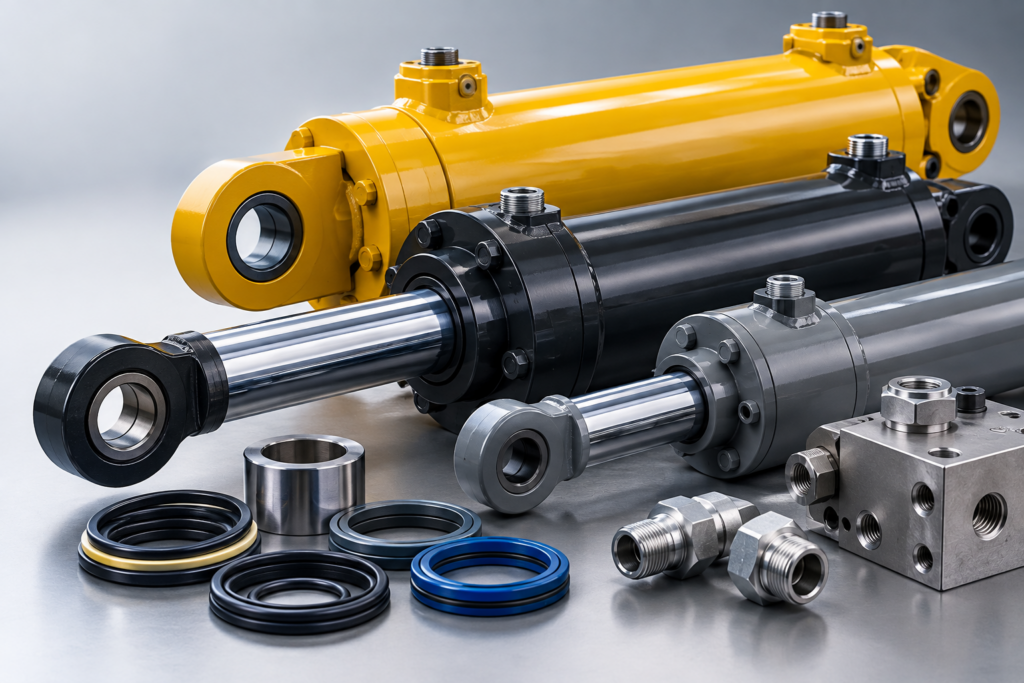
The Department of Commerce has initiated new antidumping and countervailing duty investigations covering certain linear hydraulic cylinders and parts from several major U.S. trading partners.
The antidumping investigations cover imports from Canada, China, India, South Korea and Mexico. The countervailing duty investigations cover China, India and Mexico.
No new cash deposits are required merely because the investigations have begun. However, the proposed scope is broad and may affect companies importing agricultural, construction, material-handling and industrial machinery containing covered hydraulic cylinders.
Interested parties face a September 28 deadline to submit comments concerning the scope of the investigations.
Which Hydraulic Cylinders Are Covered?
The proposed scope covers linear acting hydraulic cylinders, also known as hydraulic power engines, that meet specified physical characteristics.
Covered cylinders generally have:
- A barrel made of steel
- A bore, or inner diameter, of at least one inch
- A retracted length of at least four inches
- Hydraulic activation
The investigations cover numerous cylinder designs, including:
- Tie-rod
- Welded body
- Telescopic
- Plunger
- Rodless
- Differential
- Position-sensing
- Single-acting
- Double-acting
- Displacement
- Ram-type
- Piggy-back
- Double-rod
- Rod-fed
- Spring-return cylinders
The inclusion of a spring does not automatically exclude an otherwise covered hydraulic cylinder.
Components Can Also Be Covered
The proposed scope reaches more than completed cylinder assemblies. It also includes certain:
- Processed steel barrels
- Steel piston rods
- Parts attached to or shipped with a covered barrel or piston rod
- Cylinder mounting components
- Pistons, rings, seals and gaskets
- Valves and sensors
- Hydraulic tubing or lines shipped with the covered cylinder
Some components imported and invoiced separately are excluded. Importers should review the complete written scope before assuming that a replacement part or unfinished component falls outside the investigations.
Cylinders Imported With Machinery May Be Included
One of the most commercially significant provisions concerns hydraulic cylinders attached to or imported with machinery or equipment classified in Chapter 84 of the Harmonized Tariff Schedule.
When a covered hydraulic cylinder is imported with qualifying machinery, the cylinder can remain subject to the investigation even though the entire machine is classified under a different tariff provision. Only the hydraulic cylinder is intended to be covered, but the importer may still need to identify and value that component.
Potentially affected machinery may include:
- Construction equipment
- Agricultural machinery
- Forklifts and material-handling equipment
- Manufacturing equipment
- Industrial presses
- Mining and forestry equipment
- Replacement machinery assemblies
This provision could affect companies that do not view themselves as hydraulic-cylinder importers.
Third-Country Processing May Not Remove Coverage
Covered cylinders, barrels and rods can remain within scope when they undergo assembly or minor processing in a third country.
The scope can also reach covered cylinders manufactured in a subject country and attached to Chapter 84 machinery in another country before importation into the United States.
Importers should therefore determine where the cylinder itself was manufactured. The country where the finished machine was assembled or shipped may not answer the trade-remedy origin question.
Covered HTSUS Classifications
The products under investigation are currently classified under the following HTSUS statistical reporting numbers: 8412.21.0015, 8412.21.0030, 8412.21.0045, 8412.21.0060, 8412.21.0075 and 8412.90.9005. As with other AD/CVD scopes, these numbers are for convenience and customs purposes only; the written description of the scope controls.
Scope Comments Are Due September 28
Commerce acknowledged concerns regarding the administrability and wording of portions of the proposed scope, particularly language describing when processed steel barrels acquire a sole or predominant use as hydraulic-cylinder barrels.
Interested parties may submit scope comments by 5 p.m. Eastern on September 28, 2026. Rebuttal comments are due by 5 p.m. Eastern on October 8.
Manufacturers and importers whose products could be unintentionally included should evaluate whether the proposed language accurately distinguishes covered cylinders and parts from general-purpose components.
What Happens Next?
The ITC will determine whether there is a reasonable indication that the imports materially injure or threaten injury to a U.S. industry. A negative determination for a particular country would end the corresponding investigation.
If the cases continue, Commerce will issue preliminary determinations under the statutory schedule. Affirmative preliminary determinations could result in suspension of liquidation and new cash-deposit requirements.
Importers should begin evaluating exposure before deposits take effect because trade-remedy liability can depend on entry timing, product design, component origin and supplier participation in the proceedings.
What Importers Should Do Now
Companies importing hydraulic equipment or Chapter 84 machinery should:
- Identify imported products containing linear hydraulic cylinders.
- Obtain cylinder specifications, including barrel material, bore size and retracted length.
- Determine where the cylinder, barrel and piston rod were manufactured.
- Review whether components are imported separately or with covered assemblies.
- Identify cylinders attached to Chapter 84 machinery.
- Compare products against the complete proposed scope.
- Consider whether scope comments are appropriate before September 28.
- Monitor the ITC and Commerce preliminary determinations.
References
- Certain Linear Hydraulic Cylinders and Parts Thereof From Canada, China, India, Korea, and Mexico: Initiation of Less-Than-Fair-Value (Antidumping) Investigations (91 FR 58060, Sept. 14, 2026)
- Certain Linear Hydraulic Cylinders and Parts Thereof From China, India, and Mexico: Initiation of Countervailing Duty Investigations (91 FR 58067, Sept. 14, 2026)
- Correction Notice: ITC Preliminary Determination Timing (91 FR 60091, Sept. 22, 2026)
- Commerce Initiation Fact Sheet: Certain Linear Hydraulic Cylinders and Parts Thereof from Multiple Countries (trade.gov)
- ACCESS Case Numbers: A-122-879 (Canada), A-570-240/C-570-241 (China), A-533-952/C-533-953 (India), A-580-923 (Korea), A-201-870/C-201-871 (Mexico)
Contact the Alba team for assistance reviewing affected products, component origin and potential exposure under the new investigations.
Subscribe to the ASK Alba™ Trade Brief for timely updates on antidumping and countervailing duty proceedings and other import-compliance developments. Contact Alba