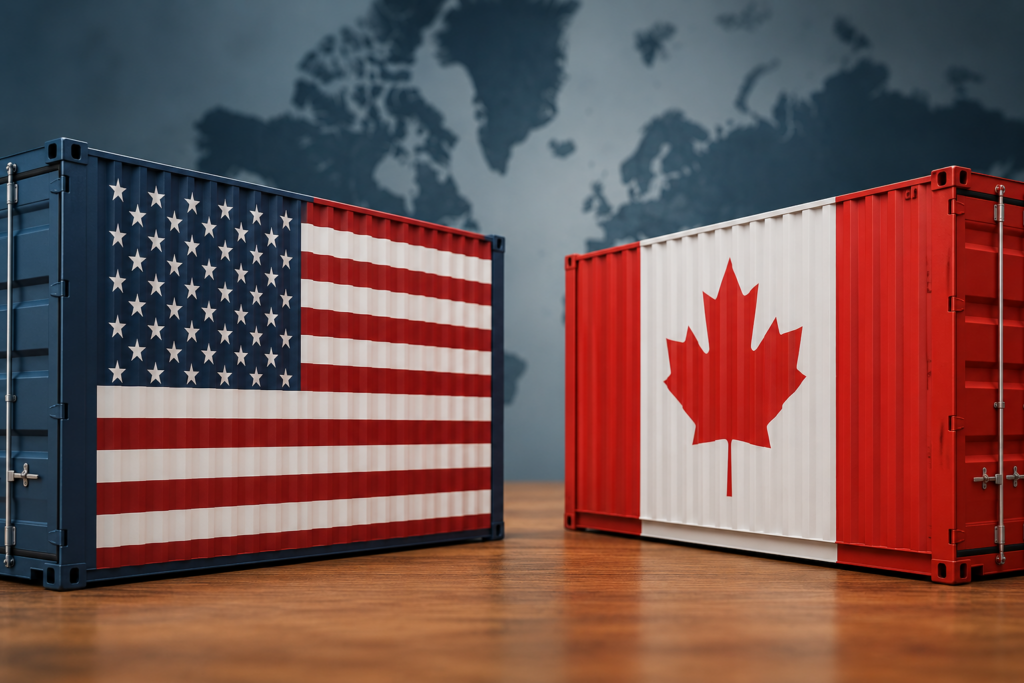
Canada has imposed new counter-tariffs of 15%, 25% and 50% on approximately C$27.6 billion in products imported from the United States, effective September 8, 2026.
The measures respond to recent U.S. tariffs on Canadian merchandise and target many of the industries most directly affected by the U.S. actions. The Canadian list includes specified steel, dairy, appliances, agricultural equipment, electronics, pulp and paper, and other goods.
For U.S. exporters, the measures create an immediate pricing and customer-retention issue. For Canadian importers, they create a classification, origin and customs-valuation issue that must be resolved before calculating the additional duty.
Product Coverage Must Be Confirmed by Tariff Classification
The counter-tariffs do not apply to every product within a targeted industry. Coverage is determined by the tariff items and descriptions included in Canada’s official list.
Companies should review the Canadian Customs Tariff classification of each product rather than relying on a commercial description. A product described broadly as an appliance, electronic component or piece of agricultural equipment may or may not fall within a listed provision.
Canada has published an authoritative consolidated list showing the applicable tariff item, description, effective date and rate. Exporters should coordinate with their Canadian importer or customs broker to confirm coverage before quoting new orders.
U.S. Origin, Not Shipment Route, Controls
The measures apply to qualifying goods originating in the United States. Routing a U.S.-origin product through another country generally will not change its origin or avoid the counter-tariff.
At the same time, products shipped from the United States are not automatically U.S.-origin. Canadian importers should apply Canada’s applicable origin and marking rules and retain documentation supporting the determination.
This distinction is particularly important for distributors shipping foreign-origin inventory from U.S. warehouses and manufacturers whose finished products contain inputs from multiple countries.
Contracts and Pricing Need Immediate Review
Tariffs of 15% to 50% can quickly eliminate the margin on an existing transaction. Companies should review which party is responsible for import duties under their Incoterms and sales agreements.
U.S. exporters should also prepare for requests to:
- Reduce prices or share the tariff cost
- Delay or cancel open orders
- Change the importer of record
- Source substitute products outside the United States
- Provide additional origin documentation
Any pricing adjustment should be documented carefully. Artificially lowering the declared value without a commercially supportable basis can create a separate customs-valuation problem.
Relief May Be Available in Exceptional Circumstances
The Canadian government has maintained a tariff-remission process for exceptional cases. Remission is not automatic, and businesses generally must demonstrate factors such as a lack of reasonable alternatives or severe economic harm.
Companies considering a request should begin documenting sourcing efforts, operational consequences and the availability of Canadian or non-U.S. substitutes. Relief should be treated as a potential longer-term option, not a reason to delay payment of duties currently due.
Steps for Cross-Border Businesses
U.S. exporters and Canadian importers should:
- Screen products against Canada’s official tariff list.
- Confirm Canadian tariff classifications and origin determinations.
- Identify open orders and goods already moving through the supply chain.
- Review Incoterms, duty clauses and price-adjustment provisions.
- Update landed-cost calculations and customer communications.
- Preserve supporting records for any claimed transitional treatment.
- Evaluate remission only where the commercial facts justify a request.
Review the Government of Canada’s implementation notice, the authoritative product list and the remission-request process.
Contact the Alba team for assistance assessing product coverage, cross-border documentation and the logistics implications of the new Canadian tariffs.
Subscribe to the ASK Alba™ Trade Brief for timely updates affecting trade between the United States and Canada.
References
- Government of Canada, Department of Finance, “Canada announces targeted countermeasures and substantive support for workers and businesses in response to U.S. tariffs” (August 28, 2026) — https://www.canada.ca/en/department-finance/news/2026/08/canada-announces-targeted-countermeasures-and-substantive-support-for-workers-and-businesses-in-response-to-us-tariffs.html
- Government of Canada, Department of Finance, “List of products from the United States subject to counter-tariffs effective September 8, 2026” — https://www.canada.ca/en/department-finance/news/2026/08/list-of-products-from-the-united-states-subject-to-counter-tariffs-effective-september-8-2026.html