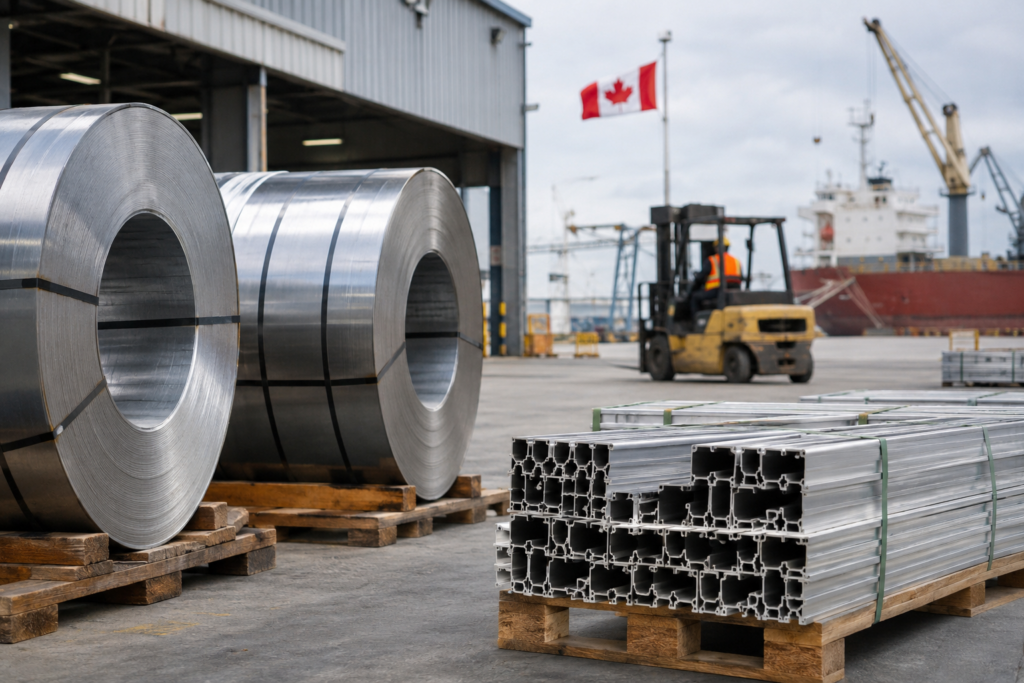
The list of Canadian products subject to the additional 50% duties under Section 338 of the Tariff Act of 1930 has changed again. On October 23, 2026, the President signed a proclamation further modifying Proclamation 11048, the Section 338 action tied to Canada’s treatment of U.S. motor vehicles. U.S. Customs and Border Protection (CBP) followed on October 29 with filing guidance in CSMS #70314289.
Effective for covered merchandise entered for consumption, or withdrawn from warehouse for consumption, on or after 12:01 a.m. Eastern on October 30, 2026, 100 additional Harmonized Tariff Schedule (HTSUS) classifications are subject to the 50% duty under HTSUS 9903.03.14. At the same time, 22 classifications were removed from the list.
This is the third scope change since the duties took effect on August 22, 2026, following a modification effective September 15. Importers cannot rely on the Canadian product reviews, landed-cost calculations, or customs broker instructions they used before October 30. Merchandise that was previously outside the tariff may now carry an additional duty equal to half its entered value.
What Changed on October 30?
According to CBP, the October 30 changes apply only to merchandise reported under HTSUS 9903.03.14. The classifications associated with 9903.03.12 and 9903.03.13 remain unchanged.
The newly covered classifications span multiple industries. Examples include selected:
- Cocoa powder and chocolate preparations
- Paints, varnishes, and caulking or sealing compounds
- Hair-care products, soaps, and detergents
- Lubricants, laboratory reagents, and chemical waste products
- Plastic and rubber articles, including plastic floor coverings
- Fiberboard, wood moldings, pallets, and paper and paperboard products
- Carpets and other textile floor coverings
- Air conditioners, chest-type freezers, power tools, and valves
- Medical, laboratory, and demonstration instruments
- Yachts and other pleasure vessels, and certain sporting goods
Carpets and floor coverings account for the largest share of the new lines. Most of the additions have no obvious connection to motor vehicles, even though they fall under the motor-vehicle proclamation. Coverage is determined by the specific HTSUS classifications on the updated list, not by how merchandise is marketed or used.
Importers should therefore conduct a classification-level review instead of relying on broad product descriptions or industry labels.
Twenty-Two Classifications Were Removed
The October 30 modification also removes 22 classifications from the 50% tariff list, including selected:
- Plywood and other veneered panels
- Plastic sheets, film, boxes, crates, and bags
- Coated paper and paperboard
- Cartons, boxes, and other paper articles
- Refrigeration, heat-treatment, packing, and produce-cleaning machinery
- Certain seaweed and other algae
Importers should identify products that were previously reported under 9903.03.14 but are no longer covered. Broker instructions and product databases should be updated to prevent unnecessary payment of the additional duty on entries made on or after October 30.
The effective date is tied to the date merchandise is entered for consumption or withdrawn from warehouse for consumption. It is not based solely on the shipment, export, or arrival date.
The Additional Duty May Stack With Other Charges
The 50% Section 338 duty is additional to other applicable duties, taxes, fees, and trade-remedy charges. The October 23 proclamation and White House fact sheet state expressly that it applies in addition to Section 232 duties.
Depending on the product, an importer may also owe:
- Normal Column 1 duties
- Section 232 duties
- Section 301 duties
- Antidumping or countervailing duties
- Merchandise processing fees
- Harbor maintenance fees
- Other product-specific duties or charges
For example, chest-type freezers that previously paid only Section 232 steel duties will now owe the 50% Section 338 duty as well. USMCA eligibility does not, by itself, remove a product from the Section 338 action; the White House confirms the duties apply regardless of USMCA origin.
The complete duty calculation should be reviewed before importers confirm prices, purchase orders, or delivery terms.
Exceptions, Chapter 98, and Foreign-Trade Zones
CBP’s guidance retains several important special rules.
Since September 15, 2026, only goods subject to HTSUS 9903.03.13 are eligible for the 0% exception under 9903.03.15, which covers certain Section 232 products (steel, aluminum, copper, vehicles and parts, wood products, semiconductors, and patented pharmaceuticals). Merchandise reported under 9903.03.14 cannot use that provision. A separate 0% exception under 9903.03.16 remains available for qualifying civil aircraft, engines, parts, and ground flight simulators.
Additional duties generally do not apply to products properly entered under qualifying Chapter 98 provisions. However, special rules apply to merchandise returned after repairs, alterations, processing, or assembly abroad (subchapter XXIII and subheadings 9802.00.40, 9802.00.50, 9802.00.60, and 9802.00.80). In those cases, the additional duty applies to the value of the work performed abroad or, for 9802.00.80, to the value of the assembled article less the cost of U.S.-origin components.
Covered Canadian products admitted to a U.S. foreign-trade zone must be admitted in privileged foreign status unless the merchandise qualifies for domestic status.
CBP has also confirmed that the Section 338 duties under 9903.03.12 through 9903.03.14 are eligible for drawback. Importers that subsequently export or destroy qualifying merchandise should evaluate whether the additional duties can be recovered.
What Importers Should Do Now
Importers of Canadian merchandise should:
- Obtain the complete October 30 HTSUS list from CBP and Annex I of the October 23 proclamation.
- Compare every imported Canadian classification with the revised list.
- Identify products newly subject to 9903.03.14.
- Identify products removed from the tariff action.
- Update broker instructions, classification databases, and landed-cost systems.
- Review entries filed on or after October 30 for correct Chapter 99 reporting.
- Recalculate pricing and duty exposure for affected purchase orders.
- Evaluate Chapter 98, foreign-trade zone, and drawback opportunities.
- Confirm whether Section 232, Section 301, or AD/CVD duties also apply.
- Monitor CBP guidance for additional revisions or filing instructions.
The repeated changes to the Canadian tariff lists make ongoing classification monitoring essential. A product’s treatment can change even when its supplier, origin, classification, and physical characteristics remain the same.
Questions on Section 338 entry filing can be directed to CBP at TradeRemedy@cbp.dhs.gov.
References
- CBP CSMS #70314289: Further Modifying Section 338 Additional Duties on Certain Goods of Canada (October 29, 2026)
- CBP Section 338 Canada Modified HTS List (October 30, 2026 additions in bold)
- White House Proclamation: Further Modifying the Scope of Products of Canada Subject to the Additional Duties (October 23, 2026)
- Annex I: Affected HTSUS Provisions (Part A removed, Part B added)
- Annex II: Modifications to the HTSUS
- White House Fact Sheet: President Donald J. Trump Further Modifies Canadian Products Subject to Tariffs Under Section 338
- Proclamation 11048, 91 FR 46663 (Federal Register, July 23, 2026)
- CBP CSMS #69851916: Guidance on Modified Section 338 Duties (September 2026)
ASK Alba™: Contact the Alba team for assistance reviewing Canadian classifications, correcting broker instructions, calculating duty exposure, or evaluating available duty-recovery strategies.
Subscribe to the ASK Alba™ Trade Brief for timely updates on tariffs, customs requirements, and cross-border trade developments.