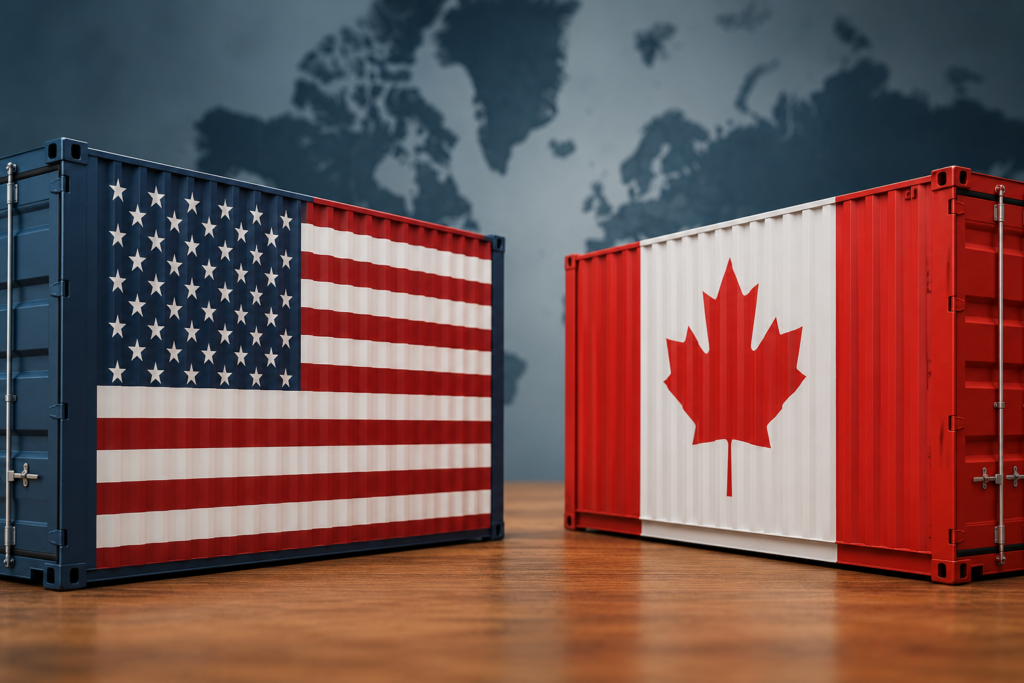
Canada will impose new counter-tariffs of 15%, 25%, and 50% on approximately C$27.6 billion in U.S.-origin goods beginning September 8, 2026.
The Canadian government announced the measures in response to U.S. Section 338 tariffs that took effect on selected Canadian products August 22, as well as certain U.S. Section 232 measures.
The counter-tariffs create immediate pricing and planning concerns for U.S. exporters and Canadian importers across the dairy, steel, wood, paper, electronics, cosmetics, agricultural equipment, and appliance sectors.
When the Counter-Tariffs Take Effect
Canada’s countermeasures take effect at 12:01 a.m. on September 8, 2026.
The measures apply only to listed goods that originate in the United States. For purposes of the counter-tariffs, U.S.-origin goods are those eligible to be marked as goods of the United States under Canada’s country-of-origin marking regulations for CUSMA, known in the United States as the USMCA.
The tariffs do not apply to U.S. goods that are already in transit to Canada when the measures take effect. Exporters and importers relying on the in-transit exception should retain transportation and commercial records demonstrating when the goods began their movement to Canada.
Tariff Rates Vary by Product
Canada will apply additional tariffs of 15%, 25%, or 50%, depending on the Canadian tariff item assigned to the imported product.
The product list focuses on sectors affected by the corresponding U.S. measures, including:
- Dairy products and dairy ingredients
- Steel and articles of steel
- Wood, plywood, pulp, and paper products
- Appliances and household goods
- Agricultural equipment
- Electronics and electrical equipment
- Cosmetics and personal-care products
- Plastics and plastic articles
- Honey, molasses, and certain prepared foods
- Machinery and industrial products
The rate is determined at the individual Canadian tariff-item level. Companies should not assume that every product within a broad category receives the same tariff treatment.
For example, the list includes several dairy products at 50%, numerous cheese classifications at 25%, and selected wood products at either 25% or 50%.
USMCA Qualification Does Not Necessarily Prevent the Tariff
The counter-tariffs are based on U.S. origin rather than whether the product qualifies for preferential treatment under the USMCA.
A U.S.-origin product may therefore qualify for the agreement’s normal preferential duty rate and still be subject to the additional Canadian counter-tariff if its tariff item appears on the countermeasure list.
Exporters and Canadian importers should evaluate the normal customs duty and the additional counter-tariff separately when calculating landed cost.
Classification and Origin Require Careful Review
The countermeasure list is organized according to Canada’s Customs Tariff, not the U.S. Harmonized Tariff Schedule.
Although the U.S. and Canadian schedules share the same international six-digit Harmonized System structure, classifications can diverge beyond six digits. U.S. exporters should not rely exclusively on the HTSUS number used on an export document to determine whether merchandise is covered in Canada.
Companies should confirm:
- The applicable Canadian tariff classification
- Whether that tariff item appears on the countermeasure list
- The additional tariff rate assigned to the product
- Whether the goods meet the Canadian standard for U.S. origin
- Whether an in-transit exception applies
- Which party is contractually responsible for the additional charge
Product descriptions provided with the government list are indicative. The Canadian tariff classification controls.
Commercial Effects May Extend Beyond the Importer
The Canadian importer of record will generally pay the additional tariff at importation, but the commercial cost may be addressed through pricing negotiations, surcharges, contractual adjustments, or changes in sourcing.
U.S. exporters should review:
- Delivered-duty-paid and other Incoterms
- Customer pricing and quotation validity
- Provisions addressing new government charges
- Inventory already located in Canada
- Shipments scheduled to depart before September 8
- Alternative sourcing or manufacturing options
- Potential effects on demand from Canadian customers
Cross-border transportation providers should also prepare for possible shipment acceleration before the effective date and changing volumes after the tariffs begin.
What Companies Should Do Before September 8
U.S. exporters and Canadian importers should:
- Compare their products against Canada’s tariff-item list.
- Confirm the Canadian classification instead of relying solely on the U.S. HTSUS number.
- Review the product’s origin under Canada’s applicable marking rules.
- Identify shipments that may qualify for the in-transit exception.
- Preserve records showing when qualifying goods entered transit.
- Calculate the new landed cost using the applicable 15%, 25%, or 50% rate.
- Review contracts, Incoterms, pricing, and responsibility for government-imposed charges.
- Communicate potential cost changes to customers and supply-chain partners.
- Monitor Canada Border Services Agency guidance for filing, payment, and administration instructions.
- Continue monitoring U.S.-Canada negotiations for possible modifications or relief.
The measures are scheduled to take effect with a short implementation period. Companies should complete product-level reviews before cargo reaches the Canadian border.
ASK ALBA™
Contact the Alba team for assistance evaluating cross-border classifications, origin requirements, shipment timing, and the commercial effects of the new tariffs.
Contact Alba to speak with a trade compliance expert
References