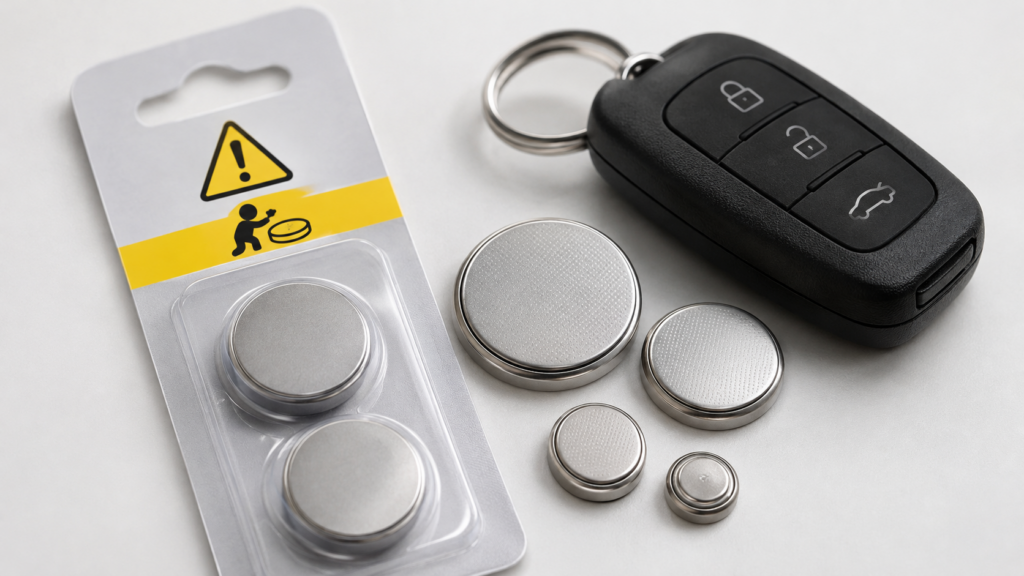
Importers of consumer products that contain button cell or coin batteries have a new labeling detail to check. In a direct final rule published in the Federal Register on November 18, 2026, the U.S. Consumer Product Safety Commission (CPSC) updated its mandatory safety standard under Reese’s Law to adopt the 2026 version of the underlying industry standard, ANSI/UL 4200A. The update applies to products manufactured after February 13, 2027, unless CPSC receives a significant adverse comment by December 18, 2026.
The changes are narrow and focus on how warning labels look, not on battery compartment design or testing. Even so, importers should confirm that label artwork from overseas suppliers meets the revised requirements before production runs cross the effective date.
Background: Reese’s Law
Reese’s Law was signed in August 2022 to protect young children from the serious injuries that can result from swallowing button cell or coin batteries. It applies to consumer products that contain, or are designed to use, these batteries. The law defines a “button cell or coin battery” as any single-cell battery with a diameter greater than its height, plus any other battery CPSC determines poses an ingestion hazard.
CPSC’s standard at 16 CFR part 1263 has applied to covered products manufactured or imported since March 19, 2024. It requires products to secure batteries inside the battery compartment during foreseeable use and misuse, and requires warning labels on the product, its packaging, and its instructions. Toys are exempt from this standard because they are already covered by battery requirements in the federal toy safety standard (ASTM F963).
Under Reese’s Law, when UL revises the 4200A standard, the revision becomes the new mandatory federal requirement unless CPSC objects. This rule simply updates the Code of Federal Regulations to reflect the 2026 revision.
What Is Changing
ANSI/UL 4200A-2026 replaces ANSI/UL 4200A-2023 as the incorporated standard. According to CPSC, the two substantive changes are:
- Safety Alert Symbol size: In the sample warning label figures (Figures 7B.1 through 7B.4 and 7C.1), the Safety Alert Symbol (the triangle with an exclamation point) must be at least as tall as the signal word “WARNING.”
- Single-color molded or stamped markings: Section 7C.2 now clarifies that the alternative product marking, used when a product is too small for a full warning label, may be molded or stamped into the product in a single color.
CPSC did not identify any changes to battery compartment performance requirements, test methods, or the separate warning requirements for battery packaging.
Testing and Certification
The usual certification rules continue to apply, with the 2026 standard as the reference for products manufactured after the effective date:
- Children’s products: Must be tested by a CPSC-accepted third-party laboratory and covered by a Children’s Product Certificate (CPC).
- General-use products: Must be covered by a General Certificate of Conformity (GCC) based on testing of each product or a reasonable testing program.
CPSC says laboratories already accredited to test to the 2023 version can test to the 2026 version, and their accreditations will be updated at renewal. Requirements for lead, phthalates, tracking labels, and consumer registration are unchanged.
Why This Matters for Importers
Under the Consumer Product Safety Act, importers are treated as manufacturers and are responsible for certifying that their products comply. CPSC works with CBP to screen consumer products at ports of entry, and Reese’s Law compliance has been an active enforcement area since 2024. A label that misses a detail such as symbol height could lead to a detained shipment, a refused entry, or a recall.
Because the effective date is based on manufacture date rather than entry date, goods manufactured on or before February 13, 2027 may still be certified to the 2023 version. Goods manufactured after that date must meet the 2026 version, so importers should keep clear records of production dates for shipments arriving around the transition.
What Importers Should Do Now
- Audit label artwork: Check warning labels on products, packaging, and instructions to make sure the Safety Alert Symbol is at least as tall as the word “WARNING.”
- Brief your suppliers: Make sure overseas factories update label files before production runs that will be completed after February 13, 2027.
- Update certificates: Revise CPCs and GCCs to reference ANSI/UL 4200A-2026 for products manufactured after the effective date.
- Confirm your lab: Ask your testing laboratory whether it is ready to test to the 2026 version.
- Track production dates: Keep documentation showing when goods were manufactured, especially for shipments arriving near the transition.
- Comment if needed: Submit any significant concerns to CPSC under Docket No. CPSC-2023-0004 by December 18, 2026.
ASK Alba™
Have questions about CPSC requirements, product certificates, or how to keep consumer product shipments moving at the border? Alba’s trade compliance team can help. Contact us today.
References
- Federal Register: Safety Standard for Button Cell or Coin Batteries and Consumer Products Containing Such Batteries (Nov. 18, 2026)
- Direct final rule PDF (GovInfo)
- CPSC Business Guidance: Button Cell and Coin Battery
- CPSC: Button Cell and Coin Battery FAQs
- UL Standards & Engagement: free read-only access to incorporated standards
- CPSC contacts: Carolina Abraham, Compliance Officer, (301) 504-7603, cabraham@cpsc.gov; Daniel Taxier, Project Manager, (301) 987-2211, dtaxier@cpsc.gov