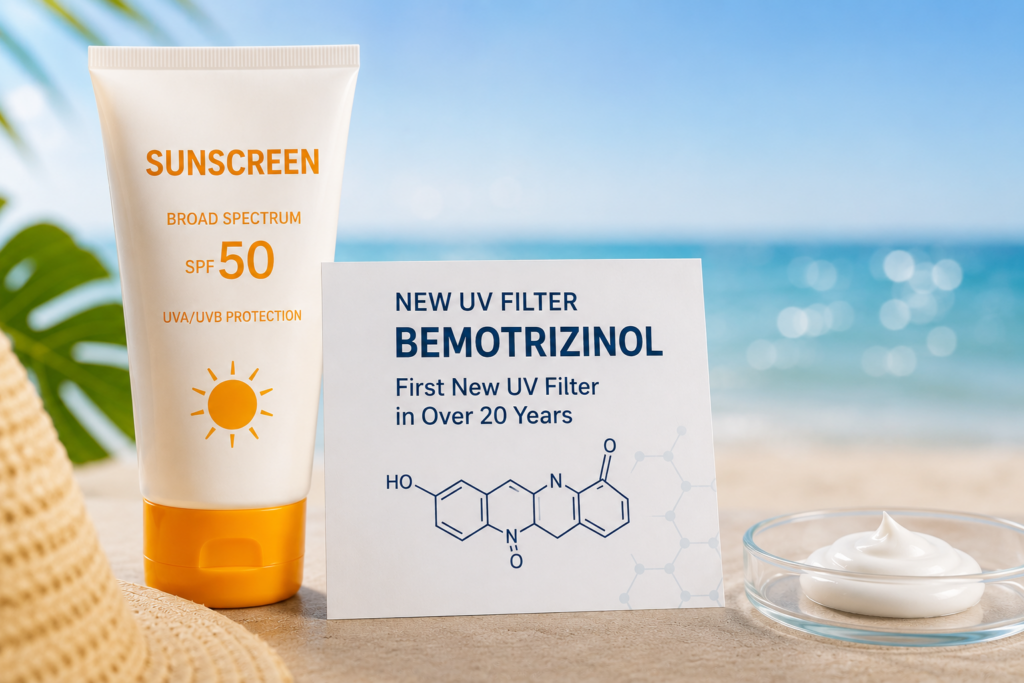
The FDA has expanded the list of permitted U.S. sunscreen active ingredients for the first time since the late 1990s, finalizing approval of bemotrizinol — a move with direct implications for importers and distributors of finished sunscreen products and raw cosmetic ingredients alike.
What Changed
On June 9, 2026, the FDA issued a final administrative order (OTC000039) amending OTC Monograph M020 — the regulatory “recipe book” governing sunscreen drug products sold in the United States — to add bemotrizinol as a permitted active ingredient at concentrations up to 6%. The order was published in the Federal Register on June 10, 2026, and becomes effective August 9, 2026.
Bemotrizinol, also marketed internationally as Tinosorb S or under the trade name PARSOL Shield, has been used safely in sunscreen products across Europe, Asia, and Australia for more than 25 years. Until now, the U.S. monograph system — last updated with a new active ingredient in the late 1990s — had no domestic pathway for it.
Why This Matters for Importers
Bemotrizinol cleared FDA review through the streamlined OTC Monograph Order Request (OMOR) process established under the CARES Act, with DSM Nutritional Products LLC submitting the request that the FDA ultimately finalized within seven months of its proposed order. The approval is significant for trade compliance teams for several reasons:
- Finished sunscreen products manufactured abroad with bemotrizinol as an active ingredient — previously excluded from the U.S. market absent an individually approved drug application — can now be marketed in the U.S. without one, provided they meet all OTC Monograph M020 conditions.
- DSM-Firmenich holds an 18-month period of exclusivity tied to its OMOR submission, a factor that will shape which formulators and brands can bring bemotrizinol-containing products to the U.S. market first.
- Importers of raw bemotrizinol or finished formulations should confirm FDA drug establishment registration and listing requirements are met before goods ship, since monograph eligibility does not substitute for these baseline OTC drug compliance obligations.
Compliance Conditions Under the Final Order
The final order specifies permitted dosage forms for bemotrizinol-containing sunscreens — oil, lotion, cream, gel, butter, paste, ointment, stick, and spray — with spray products required to either contain no propellant or use a delivery system that isolates the propellant from the drug formulation. The order also sets conditions for combining bemotrizinol with other sunscreen actives and with skin protectant ingredients.
FDA considers bemotrizinol generally recognized as safe and effective (GRASE) for adults and children six months of age and older, based on review of efficacy data, animal safety assays, and human exposure studies submitted as part of the OMOR process.
What Importers Should Watch
- Confirm whether any finished sunscreen products in your supply chain already use bemotrizinol internationally and assess U.S. market entry timing relative to the August 9, 2026 effective date and DSM-Firmenich’s exclusivity period.
- Verify FDA drug establishment registration, drug listing, and SPF/broad-spectrum testing compliance before shipping reformulated products — monograph eligibility alone does not clear goods for import.
- Review labeling requirements under the amended monograph, including permitted claims and combination restrictions with other actives.
- Track whether additional internationally available UV filters, such as bisoctrizole, follow a similar OMOR pathway in the months ahead.
ASK Alba™
Answers • Solutions • Knowledge
Bringing bemotrizinol-containing sunscreen products into the U.S. market requires careful alignment with FDA’s monograph conditions, labeling rules, and registration requirements. Alba’s trade advisory team can help cosmetics and OTC drug importers assess compliance ahead of formulation and shipping decisions.
Contact us: https://albawheelsup.com/contact-us/