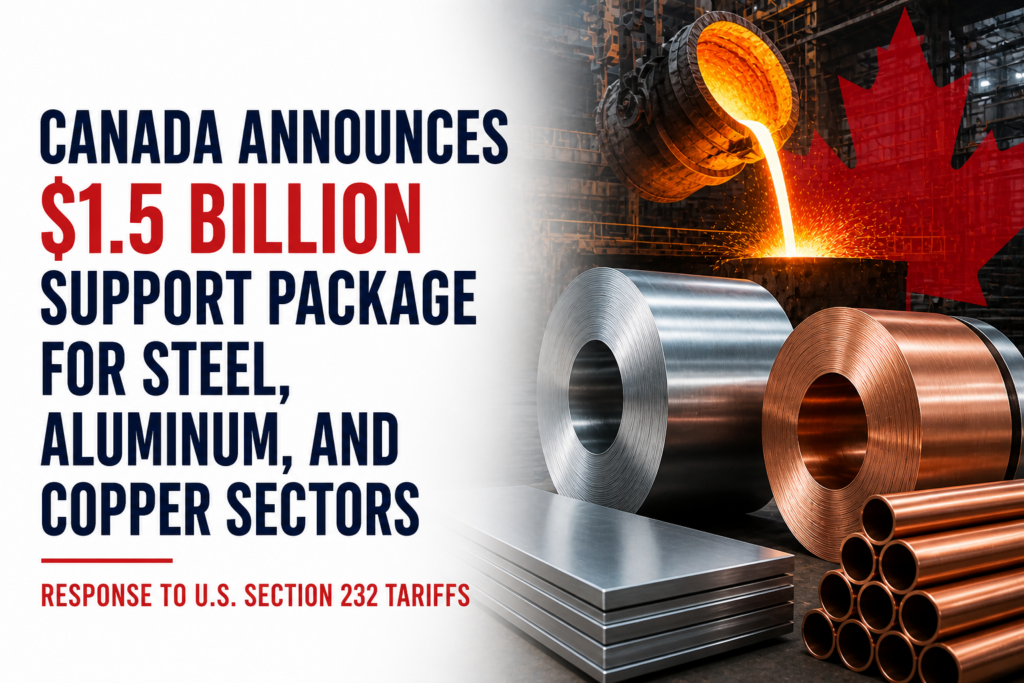
The Government of Canada has unveiled a $1.5 billion support package for businesses affected by U.S. tariffs on steel, aluminum, and copper, responding to what industry observers describe as a sector under significant pressure. Canada’s steel export value has reportedly fallen to roughly one-third of pre-tariff levels, prompting federal intervention through a mix of financing and regional support.
Section 232 Tariff Expansion Driving Market Disruption
The immediate catalyst was the April 6 expansion of Section 232 tariffs by the Trump administration. The update imposed 50 percent duties on goods made primarily of steel, aluminum, or copper, and extended 25 percent tariffs to previously exempt derivative products, including steel coils and aluminum sheets.
The policy shift has had cascading effects across Canadian manufacturing. Recreational vehicle manufacturer BRP Inc., known for Sea-Doo and Ski-Doo products, withdrew its fiscal 2027 financial outlook, citing an estimated $500 million cost impact tied to the tariff changes.
Breakdown of Canada’s Support Package
Announced May 4, 2026, in Vars, Ontario, the support package includes two primary components:
- $1 Billion Loan Program
Administered by the Business Development Bank of Canada, this program offers:- Three-year financing terms
- Zero interest in the first year, followed by low rates
- No repayment required during the loan term
- Loan sizes ranging from $2 million to $50 million
- $500 Million Regional Tariff Response Initiative (RTRI)
Designed to support small and mid-sized businesses, this funding will:- Help companies diversify export markets
- Support productivity and operational improvements
- Be distributed through regional development agencies
Broader Supply Chain Impacts
The impact extends beyond manufacturers. Reduced demand for finished metal products is expected to affect upstream mining operations, including iron ore, bauxite, and copper production. This highlights the interconnected nature of global metals supply chains and the wider implications of tariff policy shifts.
Policy Outlook and Trade Considerations
Canadian officials have acknowledged ongoing uncertainty surrounding U.S. trade policy. Industry Minister Mélanie Jolynoted that while Canada cannot control U.S. decisions, it will continue to support domestic industries.
Prime Minister Mark Carney has indicated that metals tariffs may be addressed as part of broader CUSMA renegotiation discussions with the Trump administration.
How This Impacts Importers
Shifts in North American metals trade can create downstream cost pressures, sourcing challenges, and compliance considerations for U.S. importers. Companies relying on Canadian suppliers may experience pricing volatility, supply disruptions, or changes in tariff exposure depending on product classification and origin.
The Alba Group helps clients navigate evolving tariff environments with clarity and precision—from classification strategy and duty mitigation to sourcing adjustments and compliance advisory.
Sources: Wealth Professional · BNN Bloomberg · Bloomberg · Canadian Mining Journal · CBC News · Government of Canada
Contact Us: https://albawheelsup.com/contact-us/